Orleans vs Kanata: An Honest Comparison

Orleans and Kanata are Ottawa's two largest suburban communities, sitting on opposite ends of the city like bookends. Both have populations exceeding 100,000. Both offer family-oriented neighbourhoods with good schools, parks, and shopping. And both inspire a certain loyalty among their residents that can shade into rivalry, usually good-natured, occasionally not.
If you are choosing between them, the decision is worth taking seriously. These communities are different in ways that affect daily life, career options, commute times, and the overall feel of your neighbourhood. This comparison is written from an Orleans-based site, and we will be upfront about that. But the goal is honesty, not cheerleading. Both communities have genuine strengths and real drawbacks.
Housing and Affordability
Orleans has historically offered a slight price advantage over Kanata, though the gap has narrowed in recent years. As of recent market data, the average resale home price in Orleans runs roughly $550,000 to $650,000, while Kanata's average tends to sit $25,000 to $75,000 higher depending on the quarter and the neighbourhood. The difference is more pronounced at the entry level. Townhomes and starter homes in Orleans' newer developments like Avalon are generally more affordable than comparable new builds in Kanata's Stittsville-area expansion.
For current listings and price data across both areas, realtor.ca provides the most up-to-date market information. At the upper end, both communities have expensive pockets. Kanata's Bridlewood and Kanata Lakes neighbourhoods include homes well above $800,000, as do Orleans' Chapel Hill and Fallingbrook areas. The overall housing stock is similar in type: townhomes, semis, and detached homes dominate both communities, with a smaller condo segment in each.
For a deeper look at the Orleans market specifically, see our real estate and housing guide.
Winner: Orleans, by a modest margin. The savings are real but not dramatic. If housing cost is your primary driver, Orleans gives you slightly more for your money.
Commute and Transit
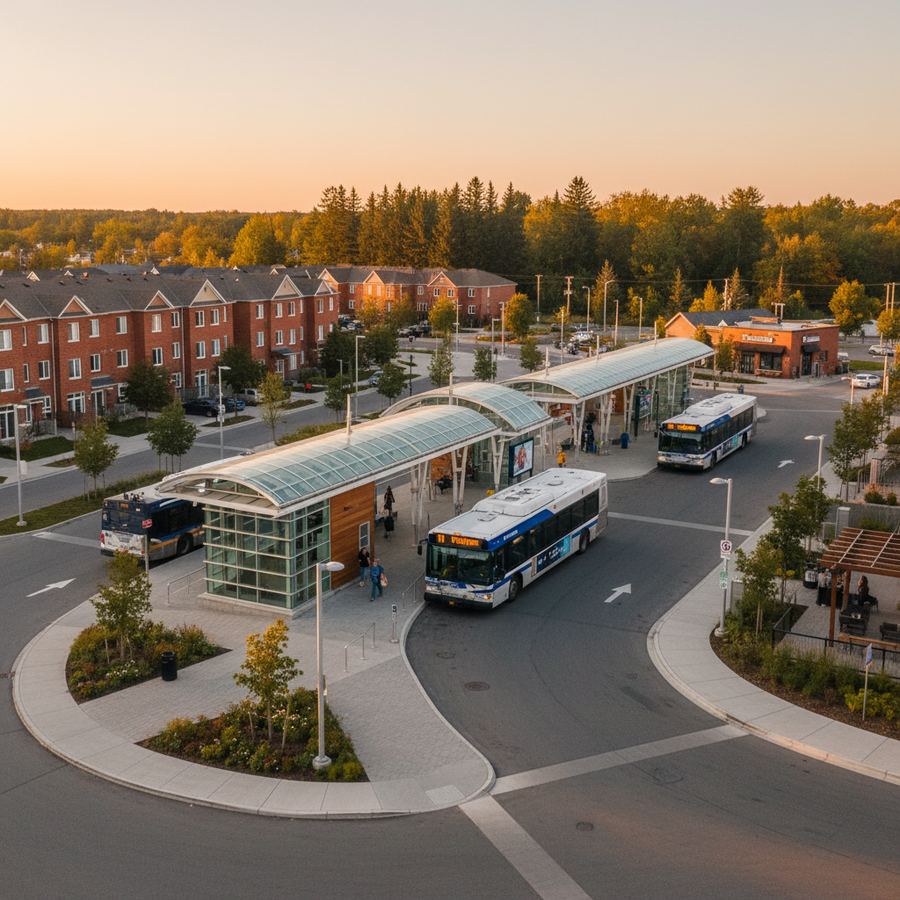
This is where the comparison gets complicated, and where both communities have genuine frustrations.
The drive from central Orleans to downtown Ottawa takes approximately 20 to 25 minutes outside rush hour via Highway 174. During the morning rush, that can stretch to 40 to 55 minutes depending on traffic and your exact start point. The drive from central Kanata to downtown via Highway 417 takes a similar 20 to 25 minutes off-peak, with rush-hour times in the same 40 to 55 minute range.
On transit, Kanata currently has a slight edge. The existing Confederation Line LRT extends west to Moodie Drive, with bus rapid transit connections into Kanata. The Stage 2 west extension will bring LRT closer to central Kanata. On the east side, Stage 2 will extend the Confederation Line into Orleans with stations at Jeanne d'Arc, Orleans Boulevard, Place d'Orleans, and Trim Road. But this extension has faced delays, with completion now projected in the 2026 to 2028 timeframe.
When the eastern extension opens, the transit picture will be more balanced. But as of now, Kanata residents have somewhat better rapid transit access. Orleans relies more heavily on bus service and park-and-ride lots. For more on the current and future transit situation, see our transit and commuting guide.
There is one scenario where Orleans has a clear commute advantage: if you work in Gatineau or eastern Ottawa. Highway 174 provides quick access to the Macdonald-Cartier Bridge and the federal government offices in Hull-Gatineau. Kanata residents heading to Gatineau face a cross-city drive that can easily exceed an hour.
Winner: Roughly even, with an edge to Kanata on current transit access and an edge to Orleans for eastbound and Gatineau-bound commuters.
Employment and Economy
This is Kanata's strongest card. The Kanata North technology park is one of Canada's largest, home to hundreds of technology companies including major employers like Nokia, Ciena, Mitel, Solace, and dozens of smaller firms. Shopify, while headquartered downtown, has a significant Kanata presence. For anyone working in technology, living in Kanata means the possibility of a five-minute commute instead of a forty-minute one.
Orleans has no equivalent employment cluster. The local economy is built on retail, services, health care, and government. Most Orleans residents who work in the private sector commute west to downtown, Kanata, or the west end. Federal government employment is a major factor on both sides of the city, with many public servants in Orleans commuting to offices downtown or in Gatineau.
This gap matters. If you or your partner works in tech, Kanata offers a quality-of-life advantage that is hard to replicate. If you work for the federal government and your office is downtown or in Gatineau, Orleans is equally good or better positioned.
Winner: Kanata, decisively, for tech workers. Orleans for Gatineau-based government workers. Even for downtown workers.
Schools and Education
Both communities are well served by all four Ontario school boards: English public, English Catholic, French public, and French Catholic. Both have strong elementary and secondary schools, and both offer French immersion programs.
The difference is in the depth of French-language infrastructure. Orleans has a significantly larger francophone population, which means French-language schools are more numerous, better enrolled, and more deeply integrated into community life. If raising bilingual children or educating them in French is a priority, Orleans has a clear advantage. The variety of French-language options, from full francophone schools to immersion programs at various entry points, is broader here than in Kanata.
Kanata has strong English-language schools and a growing francophone population, but it does not match Orleans' depth in this area. For a detailed look at educational options, see our schools and education page.
Winner: Orleans for French-language education and bilingualism. Roughly even for English-language schooling.
Culture, Language, and Community Feel
This is the most subjective comparison, but it is also one of the most important. Orleans and Kanata feel different when you live in them.
Orleans is genuinely bilingual. French and English coexist in daily life, not just on government signs. You hear both languages at the grocery store, the arena, and the school pickup line. The community has a strong francophone identity alongside its anglophone population, and the interaction between the two creates a cultural texture that is distinctly National Capital Region. It also has a notably diverse population, with significant Lebanese, South Asian, African, and Caribbean communities that are reflected in the restaurant scene, the retail mix, and the social fabric.
Kanata's identity is more defined by the technology sector. The community has a well-educated, high-income demographic profile, and the tech industry influences everything from the restaurant scene to the types of businesses that open. Kanata is less bilingual than Orleans, more anglophone on balance, though French-language services are available. The diversity is growing, particularly in newer subdivisions, but the dominant cultural note is suburban professional rather than multicultural bilingual.
Neither is better in absolute terms. If you value bilingualism and multicultural diversity, Orleans aligns more naturally. If you prefer a community oriented around technology, innovation, and a strong professional class, Kanata may feel more like home.
Winner: Depends on what you value. Orleans for bilingualism and cultural diversity. Kanata for tech-industry culture.
Shopping, Dining, and Amenities
Both communities have large shopping centres. Place d'Orleans anchors the east end. Bayshore Shopping Centre and Tanger Outlets serve the west. The retail offerings are comparable in scale, with the usual mix of national chains, department stores, and food courts.
For dining, Orleans has an edge in ethnic cuisine diversity, largely due to its multicultural population. The restaurant scene along St-Joseph Boulevard includes Lebanese, Vietnamese, Indian, Greek, and other cuisines that reflect the community's makeup. Kanata's dining options are solid and growing, with more upscale chain restaurants and a developing independent scene around the Kanata Centrum area.
For amenities like recreation centres, libraries, and parks, both communities are well served. Kanata has the Walter Baker Sports Centre and excellent pathway systems. Orleans has the Ray Friel Recreation Complex, Petrie Island's beaches, and Millennium Park. Both communities have farmers markets, community festivals, and active minor sports leagues.
Winner: Even on shopping. Orleans has a slight edge on diverse dining. Even on recreation and parks.
Proximity to Nature
Orleans benefits from its position on the Ottawa River. Petrie Island is a genuine asset, offering beaches, birding, and river access that Kanata cannot match locally. The Mer Bleue Bog, a nationally significant wetland, is accessible from Orleans' southern edge and offers year-round hiking and snowshoeing.
Kanata has the South March Highlands Conservation Forest, a large natural area with trails through Precambrian Shield terrain. The Carp River corridor provides additional green space. Both communities sit near the edge of the Greenbelt, which offers extensive trail networks.
Winner: Orleans, primarily because of Petrie Island and river access. But both are well positioned for outdoor recreation.
Nightlife and Entertainment
Neither community is going to win this category in any meaningful sense. Both are suburbs, and the nightlife options in each reflect that reality. You will find sports bars, casual dining, and the occasional live music night, but nothing resembling the bar, club, or live venue scene available in downtown Ottawa or the ByWard Market.
Kanata has a slight edge with the Canadian Tire Centre, home of the Ottawa Senators. Attending a game or a concert there is convenient for Kanata residents and a trek for those in Orleans. On the other hand, Orleans is closer to the downtown entertainment district, the National Arts Centre, and the ByWard Market via Highway 174.
For young adults and anyone who values evening entertainment options, neither suburb is ideal. Both require a trip to the core for a proper night out.
Winner: Even, with minor advantages depending on what you are looking for.
The Verdict

There is no objective winner between Orleans and Kanata. The right choice depends on your circumstances.
Choose Orleans if you value bilingualism and want your children to grow up in a genuinely bilingual environment. If you work in Gatineau or eastern downtown Ottawa. If you want more house for your money, even if the savings are modest. If cultural diversity and a multicultural food scene matter to you. If you want river access and beaches close to home.
Choose Kanata if you work in the technology sector and want a short commute. If current transit access matters more to you than future promises. If you prefer a community with a strong professional and innovation-oriented culture. If you want proximity to the Senators' arena and west-end amenities.
Both communities are safe, well-served by schools, and suitable for families. Both have the standard suburban trade-offs: car dependence, limited nightlife, and distance from the cultural intensity of the urban core. Neither is a wrong choice. They are simply different choices, and understanding those differences is the key to making the right one for your situation.
For a broader look at what makes Orleans distinctive, explore our family-friendly community guide and our overview of growth and development projects shaping the community's future.